T20 vs ODI vs Test: What’s the Difference in Cricket Formats?
Cricket is the only major sport in the world that is played professionally in three completely different formats, each with its own rules, its own rhythm, its own tactical vocabulary, and its own distinct relationship with time.
A T20 match and a Test match share the same bat, the same ball, and the same basic objective of scoring more runs than the opposition. Beyond those fundamentals, they are almost different sports.
Understanding the differences between them is not just useful knowledge for cricket followers. It is directly relevant to anyone who bets on cricket through SkyExchGames, because the format you are watching determines which markets are available, how the odds behave, and what analytical framework applies to each betting decision you make.
The Three Formats of Cricket: An Overview
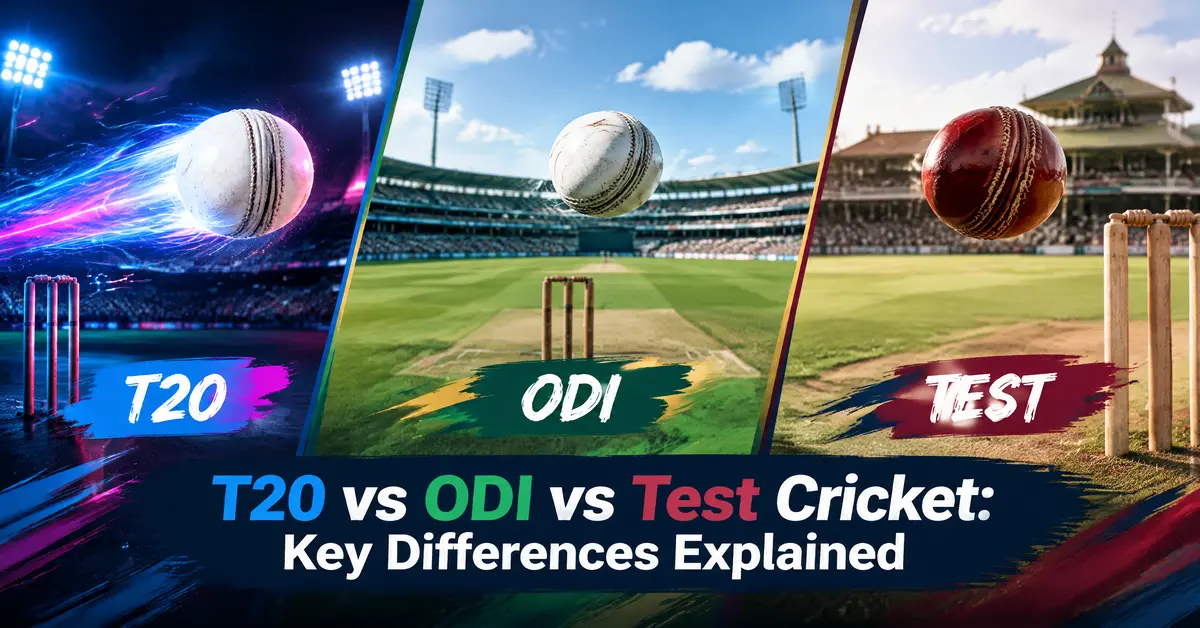
Types of cricket formats in professional cricket are three in number: Test cricket, One Day International cricket, and Twenty20 cricket. Each was developed at a different point in the sport's history and reflects a different answer to the same question of how competitive cricket should be organised.
Test cricket is the oldest format, played since 1877 and still considered by most cricket traditionalists to be the ultimate examination of a player's complete abilities. One Day International cricket arrived in the early 1970s as a response to the commercial and entertainment limitations of five-day Test cricket, creating a fifty-over format that could produce a result in a single day.
Twenty20 cricket is the newest format, introduced at the professional level in 2003 and now the dominant commercial format in world cricket through franchise leagues including the IPL, Caribbean Premier League, and The Hundred.
Cricket formats explained for beginners is a topic that usually starts with the most visible difference between them: the number of overs each team faces. But the over count is only the starting point. The rules, structures, and tactical implications of each format diverge significantly beyond simply how many overs are bowled.
How Many Overs in T20, ODI, and Test Cricket
How many overs in T20, ODI, Test is the first factual distinction between the formats. A T20 match gives each team exactly twenty overs to bat. An ODI gives each team exactly fifty overs. A Test match has no over limit per innings and no limit on the number of innings each team can bat, subject only to the five-day duration of the match.
These over counts create fundamentally different run rate requirements. In a T20 match with 120 deliveries available, every over matters immediately and the required run rate is consistently high from the opening delivery.
In an ODI with 300 deliveries, teams can afford to build an innings before accelerating, and the first fifteen overs are often played more conservatively than the death overs that follow. In Test cricket, with no over limit and potentially five days of play available, patience is not just a virtue. It is often the primary tactical instrument through which matches are won and lost.
Match duration is the most immediately visible consequence of these differences. A T20 match is typically completed in under three hours. An ODI runs for approximately seven to eight hours across a single day.
A Test match runs across up to five days with approximately ninety overs bowled per day, producing a total of potentially four hundred and fifty or more overs across the full match duration.
Test Cricket: The Five-Day Match
Test cricket is played across a maximum of five days with each team having two innings in which to bat. There is no over limit per innings, which means a batting team can in theory bat for as long as their wickets hold out across hundreds of overs if conditions and their performance support it.
The absence of an over limit is what makes Test cricket structurally unique among the three formats of cricket. It means that time itself becomes a tactical resource. A team can use time to bat the opposition out of the match by occupying the crease long enough to make a result impossible.
A bowler can be rested and reintroduced rather than burned through a fixed bowling allocation. A captain can set defensive fields to dry up runs for extended periods if protecting a lead matters more than taking wickets in a given passage of play.
The follow-on is a rule exclusive to Test cricket. If the team batting second in a Test match scores a total more than 200 runs below the first team's first innings total in a five-day match, the first team can instruct the opposition to bat again immediately rather than taking their own second innings.
This forces the trailing team into a position where they must score enough in their second innings to at least make the first team bat again before they can consider a path to victory.
Declaration is another Test-exclusive rule. A batting team can choose to end their innings voluntarily before all ten wickets have fallen if they believe they have scored enough runs to set the opposition an unchaseable target within the remaining time available.
The declaration decision is one of the most tactically complex in cricket, balancing the risk of leaving the opposition with a target they can reach against the risk of not leaving enough time to bowl them out.
ODI Cricket: One Day International
One Day International cricket was invented as a solution to the commercial limitations of Test cricket, creating a format where a result is guaranteed within a single day and where the dramatic tension of a chasing team pursuing a target is compressed into fifty overs rather than potentially four innings across five days.
Each team faces exactly fifty overs in an ODI, with each bowler limited to a maximum of ten overs. The powerplay in ODI cricket covers the first ten overs of each innings, during which fielding restrictions limit the number of fielders allowed outside the inner thirty-yard circle.
This rule forces the fielding captain to place most of their fielders in catching positions rather than boundary riders, which creates more scoring opportunities for aggressive batters and typically produces higher powerplay run rates than the middle overs that follow.
Limited overs cricket as a concept means that both teams know from the start of each innings exactly how many deliveries they have available. This transforms the tactical calculation compared to Test cricket, where the resource management question is about wickets preserved across an unlimited delivery count.
In an ODI, both wickets and overs are resources that must be managed simultaneously. A team at 100 for one after twenty overs in an ODI is in a very different position from a team at 100 for one after thirty overs, because the remaining over count defines how many deliveries are available for acceleration in the death phase.
The Test, ODI and T20 difference in bowling strategy is particularly pronounced in ODIs. Captains must plan how to distribute ten overs across their specialist bowlers while keeping their best options available for the death phase where run rates typically peak.
This bowling allocation puzzle is one of the most tactically interesting dimensions of ODI cricket for live betting analysis, because recognising when a captain has mismanaged his bowling resources creates meaningful in-play market opportunities.
Also visit for more: Cricket Betting Markets Explained (Match Winner, Top Batsman & More)
T20 Cricket: Twenty20
Twenty20 cricket compresses the competitive arc of cricket into its most intense and commercially accessible form. Twenty overs per side. One hundred and twenty deliveries. A match completed within three hours. Every ball carries immediate consequence in a way that no other format fully replicates.
The powerplay in T20 cricket covers the first six overs of each innings, with similar fielding restrictions to the ODI powerplay but compressed into six overs rather than ten. The powerplay phase in T20 cricket is proportionally more significant than in ODIs because it represents thirty percent of the entire batting allocation rather than twenty percent.
A team that loses two wickets in the T20 powerplay while scoring thirty-five runs has set a very different platform for the remaining fourteen overs than a team that scores fifty-five for one across the same six overs.
T20 vs ODI vs Test which is better is ultimately a question of personal preference and what aspect of cricket you value most. Test cricket offers the deepest examination of skill and temperament. ODI cricket offers a balanced format where both the accumulation phase and the acceleration phase are rewarded in meaningful proportions. T20 cricket offers the most immediate entertainment and the most accessible entry point for new followers of the sport.
For betting purposes, T20 cricket offers the most live markets per hour of play, the fastest odds movement, and the most frequent scoring events. Test cricket offers the richest session-by-session analytical depth and the most pronounced relationship between preparation and performance across different phases of the match. ODI cricket sits between the two in both respects.
Cricket Formats and Live Betting on SkyExchGames
SkyExchGames cricket markets reflect the format differences described in this article in how each competition is structured for live cricket betting. T20 markets on SkyExchGames update after every delivery, with session markets covering six-over powerplay blocks and individual over totals alongside match winner and top performer markets. The pace of market movement in T20 live betting on SkyExchGames reflects the format's own pace of play.
Skyexchange games cricket betting across ODI formats adds session markets covering fifteen-over blocks and the powerplay phase, alongside match winner odds that move more gradually than in T20 cricket because the longer format distributes match-defining events across more deliveries.
Test cricket markets on SkyExchGames cover session-by-session runs, day winner, innings totals, match winner, series winner, and follow-on markets that are exclusive to the five-day format.
Cricket formats on SkyExchGames are covered across the full international calendar including T20 World Cup, ODI World Cup, all bilateral Test series, and franchise competitions. Online cricket betting through SkyExchGames requires a SkyExchange Betting ID, obtained through WhatsApp in under ten minutes from the SkyExchange team. Once your account is active and funded through UPI, Paytm, or PhonePe, every format of cricket and every market described in this blog is immediately accessible through the SkyExch Games interface on any mobile browser.
Understanding which format you are watching, and what that format's specific rules, structures, and tactical logic mean for the available markets, is the analytical foundation of informed cricket betting.
The format determines the pace of the game. The pace of the game determines how the odds behave. And how the odds behave determines where the live betting opportunities exist across each match on SkyExchGames.