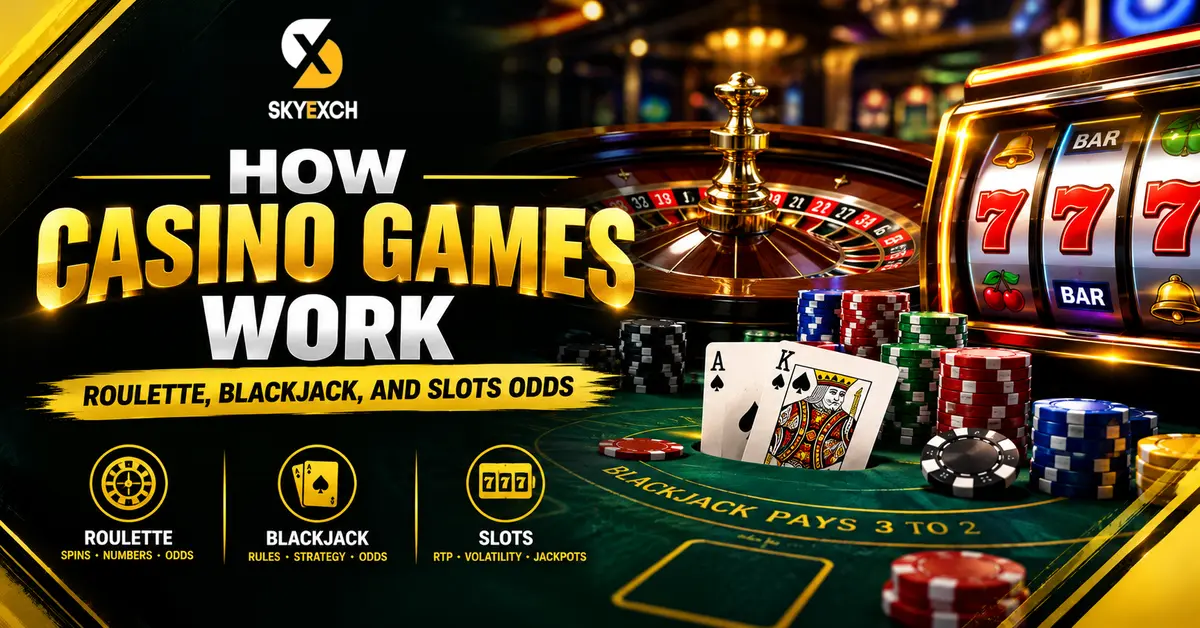
How Casino Games Work: Roulette, Blackjack, and Slots Odds
Every casino game ever invented is built on the same underlying architecture. A mathematical edge in favour of the house that is small enough to make winning feel genuinely possible across any individual session, but large enough to ensure that the house collects more than it pays out across a sufficient number of bets.
Understanding this architecture does not remove the entertainment value of casino gaming. It actually enhances it, because a player who understands why each game is structured the way it is can make better decisions about which games to play, how to play them, and what expectations to bring to each session.
This guide explains how roulette, blackjack, and slots work at the level of odds and probability, and what that means for anyone who wants to play casino games on SkyExchGames with a genuinely informed understanding of what each spin, hand, or bet is actually doing.
What is House Edge in Casino Games?
What is house edge in a casino is the first question any casino player should understand before they touch a chip, pull a lever, or place a chip on a roulette number. The house edge is the mathematical advantage built into every casino game that ensures the operator collects more than it pays out over a large number of bets.
It is expressed as a percentage of each bet that the house expects to retain over time. A house edge of two percent means that for every one hundred rupees bet across many thousands of rounds, the house expects to keep two rupees and return ninety-eight.
In any individual session, results can deviate dramatically from this expectation in either direction. A player can win significantly in a single evening against any house edge. But over a large enough number of bets, the house edge is the most reliable predictor of where money flows between the player and the operator.
Casino game odds explained through the house edge framework gives you the most important comparative tool for choosing which games to play. Different games carry dramatically different house edges, and understanding these differences is the foundation of making rational casino gaming decisions.
The difference between a game with a 0.5 percent house edge and a game with a 10 percent house edge is not a small technical detail. It is the difference between a gaming experience where your money lasts and where it disappears.
How Roulette Works: Odds and House Edge
How roulette works at the mechanical level is familiar to most casino players. A wheel with numbered pockets from zero to thirty-six, a ball that spins and falls into one of those pockets, and a betting table where players place chips on various outcome categories before each spin.
What is less familiar to many players is exactly how the pocket structure creates the house edge that makes roulette profitable for the operator.
Roulette odds explained for beginners starts with a single number bet. European roulette has thirty-seven pockets, numbered zero through thirty-six. A bet on any single number pays 35 to 1. If there were no zero pocket, the 35 to 1 payout on a 36-number wheel would represent a fair bet with zero house edge.
The zero pocket is the source of the house advantage. It creates thirty-seven possible outcomes but pays as if there were only thirty-six, and that one-pocket difference is worth approximately 2.7 percent to the house on every bet placed on the European wheel.
American roulette adds a double-zero pocket to the wheel, creating thirty-eight possible outcomes while still paying at 35 to 1 odds. The second zero pocket approximately doubles the house edge to 5.26 percent.
This is why casino games with best odds analysis consistently recommends European roulette over American roulette as a starting point. The structural difference between the two versions is not cosmetic. It is a doubling of the mathematical disadvantage on every bet placed.
Even-money bets on roulette, red or black, odd or even, and high or low, pay 1 to 1 but do not carry a 50 percent probability because the zero pocket is neither red nor black, neither odd nor even, and falls outside both the low and high ranges.
The true probability of winning an even-money bet on European roulette is eighteen thirty-sevenths, or approximately 48.6 percent, not 50 percent. The gap between the 50 percent implied by the 1 to 1 payout and the 48.6 percent true probability is the house edge expressing itself through the even-money market structure.
Blackjack Odds and How Blackjack Works
How blackjack works at the surface level is a card game where you try to accumulate a hand value closer to twenty-one than the dealer without exceeding it. At the level of odds and probability, blackjack is the most analytically rich of all traditional casino games because it is the only standard casino game where the player's decisions genuinely affect the mathematical outcome.
Blackjack odds at their best, achieved by playing perfect basic strategy, reduce the house edge to approximately 0.5 percent on standard rules. This makes blackjack the casino game with the lowest house edge of any standard table game, and it is why serious casino players consistently return to it. The 0.5 percent house edge at optimal play compares extremely favourably to roulette's 2.7 percent and slots which we will come to shortly.
Blackjack odds and probability are driven by the decisions available to the player on each hand. Hitting, standing, doubling down, splitting pairs, and surrendering are all decisions with mathematically optimal answers for every possible combination of player hand and dealer up-card.
Basic strategy charts encode these optimal decisions, and playing according to basic strategy is what produces the 0.5 percent house edge figure. Deviating from basic strategy, even on seemingly intuitive decisions, typically increases the house edge by one to two percentage points, which makes blackjack dramatically more expensive for the player over time.
The dealer up-card is the central variable in blackjack odds and probability decision-making. A dealer showing a two through six is in a weak position with a meaningful probability of busting when they take their required hits. A dealer showing a seven through ace is in a strong position.
Basic strategy adjusts the player's decisions systematically based on this dealer strength assessment, which is why understanding the dealer up-card before making any player decision is the foundation of sound blackjack play.
How Slot Machine Odds Work
How slot machine odds work is the most misunderstood topic in casino gaming, and part of that misunderstanding is structural. Unlike roulette and blackjack, where the mathematical odds are visible in the game's structure and can be calculated by any player who understands the rules, slot machine odds are embedded in software algorithms that are not visible to the player.
Slots odds are expressed through two primary metrics. Return to player, which is the theoretical percentage of total money wagered that the machine returns to players over a very large number of spins. And volatility, which describes the distribution of that return across individual sessions.
A slot with a 96 percent return to the player retains 4 percent of all money wagered over a sufficient sample. This means the house edge is 4 percent, which is already significantly higher than optimal blackjack play but meaningfully lower than American roulette. However, the range of return to players across different slot titles is enormous, from games returning 92 percent or below through to titles returning 97 percent or above.
The specific return to the player of any given slot is set by the developer at the design stage and embedded in the game's random number generator, which means it is constant across all sessions and cannot be influenced by any external factor including how long you have been playing or what the machine has paid out recently.
Volatility is the second dimension of slots odds that matters for understanding session experience. A low-volatility slot pays out smaller amounts frequently, producing a relatively steady session experience. A high-volatility slot pays out larger amounts less frequently, producing a more erratic session experience where long losing sequences are punctuated by larger individual wins.
The return to player across both types should converge to the same long-run figure, but the path to that convergence looks completely different in each case. High-volatility slots require a larger session budget to survive the variance between wins, while low-volatility slots preserve budget more steadily but cap the size of individual returns.
Casino Games with Best Odds: A Practical Comparison
Casino games with best odds analysis produces a consistent hierarchy across the major game categories. Blackjack played at basic strategy sits at the top with a house edge of approximately 0.5 percent under standard rules. European roulette follows with approximately 2.7 percent.
Baccarat on the banker bet carries approximately 1.06 percent, making it one of the best odds bets in the casino beyond blackjack. Slot machines vary widely but average around 3 to 5 percent house edge across most mainstream titles.
How do casino games work comparatively is therefore a question with a clear practical implication. If minimising the mathematical house advantage over your session is a priority, blackjack offers the best structural odds of any standard table game provided you play basic strategy consistently.
If you prefer the simplicity and visual engagement of slots and are comfortable with higher variance, selecting titles with published return to player rates above 96 percent and matching the volatility profile to your session budget is the most rational approach within that category.
This hierarchy is not a reason to avoid any particular game. It is a framework for understanding what each game costs in mathematical terms and calibrating your expectations and session budget accordingly.
Casino Games on SkyExchGames
SkyExchGames casino games cover every category discussed in this article alongside the Indian card game formats that are most culturally familiar to Indian players. Live dealer roulette on SkyExchGames uses a physical wheel and a professional dealer streaming in real time, with the European single-zero format available for players who want the better structural odds of the single-zero wheel.
Casino games on SkyExchGames include live blackjack tables across multiple stakes levels, with professional dealers managing real cards from a physical shoe in a studio environment streamed directly to your mobile browser.
The live format means there is no random number generator involved in card dealing, which makes the game verifiably closer to the physical casino experience and removes any concern about software-based outcome manipulation.
Skyexchange games casino slots library covers hundreds of titles across classic 777 formats, video slots with bonus mechanics, progressive jackpot games, and Megaways titles, with return to player information available for each game so you can make informed decisions about which titles align with your preferred risk profile.
Indian card game formats including Teen Patti and Andar Bahar are available with live dealer tables that reflect the cultural familiarity most Indian players bring to these games.
Online casino betting on SkyExchGames operates under the same account and balance as the sports betting markets, with the same same-day withdrawal processing that means casino winnings reach your bank account within sixty minutes of requesting settlement.
A SkyExchange Betting ID, obtained through WhatsApp in under ten minutes, is all that is required to access the complete casino game library alongside the full sports betting catalogue on SkyExchGames.